AI, Software Development
Introducing AgentFleet: A Smarter Architecture for AI-Powered Software Development
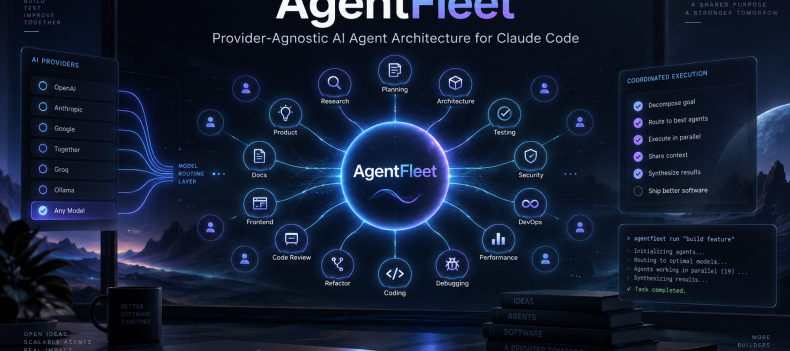
AI coding assistants are becoming increasingly capable, but as development workflows grow more autonomous, a new challenge emerges: how do you manage multiple AI agents safely, efficiently, and without locking your engineering workflow into a single AI provider?
At Sync Studios, our engineering team has been exploring this challenge through real-world development workflows.
The result is AgentFleet – an open-source, provider-agnostic architecture designed to transform Claude Code from a single general-purpose coding agent into a coordinated fleet of 19 specialized AI development agents.
AgentFleet was built around a simple principle:
The right AI model should handle the right task, with only the permissions it actually needs.
Instead of relying on one AI agent to plan architecture, inspect repositories, write code, debug problems, run tests, review changes, research documentation, and handle security analysis, AgentFleet separates these responsibilities into specialized operational lanes.
The result is a more structured approach to AI-assisted software engineering.
The Problem with the “One Agent Does Everything” Approach
Most AI coding workflows start in a straightforward way.
A developer opens an AI coding assistant and asks it to understand the repository, investigate an issue, propose a solution, modify files, run tests, and review the result.
For smaller tasks, this can work extremely well.
At scale, however, several architectural problems begin to appear.
Context becomes overloaded
Research, source-code exploration, implementation details, test logs, documentation, terminal outputs, and previous conversations all compete for the same context window.
Eventually, the agent begins carrying significantly more information than it actually needs for the task it is performing.
This can reduce both efficiency and reasoning quality.
Every task receives unnecessary permissions
An agent investigating how a function works does not need permission to modify files.
A security reviewer should not need deployment capabilities.
A planning agent should be able to study the architecture without accidentally changing the repository.
Providing every agent with the same toolset increases the potential impact of mistakes.
Development becomes tied to individual AI providers
Different AI models have different strengths.
One model may be excellent at architectural reasoning, another may be faster for straightforward code changes, while another may be more cost-effective for large repetitive operations.
Hard-coding an engineering workflow around one provider prevents teams from taking advantage of these differences.
AgentFleet was designed to address all three problems.
From One Coding Agent to 19 Specialized Lanes
AgentFleet introduces a fleet architecture consisting of 19 specialized lanes.
Instead of sending every request through the same general-purpose agent, work can be delegated according to the type of task being performed.
The fleet includes dedicated capabilities for:
- architecture and planning
- feature implementation
- automated testing
- frontend and UI development
- technical documentation
- code review
- security review
- issue diagnosis
- repository exploration
- issue triage
- codebase research
- external technical research
AgentFleet also includes alternative, fast, deep-reasoning, and cost-efficient implementation lanes.
This means a complex architectural refactor does not have to use the same model or workflow as a small syntax correction.
Each lane has a clearly defined responsibility.
Applying Least-Privilege Architecture to AI Agents
One of the most important design decisions behind AgentFleet is least-privilege access.
This is a principle commonly applied in cybersecurity and infrastructure engineering: a system should receive only the permissions required to perform its assigned function.
AgentFleet applies the same idea to AI coding agents.
Planning, code review, security analysis, diagnosis, and repository research can operate as read-only agents.
They are intentionally prevented from receiving tools capable of modifying files or executing unnecessary system-level operations.
Implementation-oriented lanes, on the other hand, can receive the tools required to modify the project.
This creates an important separation between agents that analyze the system and agents that are allowed to change it.
The primary Claude Code session remains responsible for final integration and outward-facing actions.
The architecture therefore keeps human and primary-agent control at the center of the workflow rather than allowing autonomous subagents to perform unrestricted actions.
Provider-Agnostic by Design
Another major objective behind AgentFleet was avoiding AI infrastructure lock-in.
AgentFleet can operate with:
- a Claude subscription
- the Anthropic API
- Anthropic-compatible AI gateways
- enterprise AI routing infrastructure
- multi-model gateways and proxy systems
When connected through a compatible gateway, AgentFleet can discover the models currently available and classify them according to capability.
Instead of configuring workflows around specific model names, the system thinks in terms of operational characteristics such as:
Fast – optimized for low-latency operations.
Balanced – suitable for general development.
Deep – designed for tasks requiring more advanced reasoning.
Cheap – suitable for high-volume or lower-risk workloads.
AgentFleet can then map the most appropriate available model to each development lane.
This means the architecture of the engineering workflow remains stable even when the underlying AI models change.
A team can change providers without rebuilding its complete agent configuration.
Independent AI Review
Another advantage of a multi-agent architecture is the ability to introduce independent reasoning paths.
AgentFleet includes alternative planning, implementation, and review lanes.
These alternative agents can operate using different underlying models.
For example, one model might design an implementation while another independently reviews the approach.
This reduces the risk of having the same reasoning process generate a solution and then validate its own assumptions.
For complex migrations, security-sensitive systems, concurrency problems, or changes that could create data-loss risks, deeper review lanes can also be introduced.
The goal is not simply to generate more AI output.
It is to create structured disagreement and verification within the development workflow.
Smarter Context Management
Context management becomes increasingly important as AI agents work on larger repositories and longer tasks.
AgentFleet includes automated context-budget management designed to adapt to the model currently being used.
Rather than assuming every AI model has the same context capacity, the system identifies the model’s available context window and adjusts the working limits accordingly.
This helps prevent long-running development sessions from reaching context limits unexpectedly while leaving enough headroom for the agent to continue reasoning and completing its task.
For large software projects, this becomes particularly important when agents are navigating thousands of files, reviewing implementation history, analyzing dependencies, and coordinating complex changes.
Privacy-Conscious Agent Routing
AI development infrastructure also needs to consider what information is being stored during orchestration.
AgentFleet’s routing system is designed to minimize unnecessary logging.
Operational information such as lane assignments and execution metadata can be tracked without storing complete prompt contents.
Credential-shaped information such as API keys and tokens is also treated as sensitive information and redacted from routing logs.
The objective is simple: observability should help engineering teams understand how their agent infrastructure is operating without unnecessarily reproducing sensitive development context.
Built for Real Engineering Workflows
AgentFleet was not designed as another AI chatbot interface.
It was created as infrastructure for engineering teams exploring increasingly autonomous software-development workflows.
The project addresses questions that become important when AI moves beyond occasional code generation:
How should development tasks be delegated between AI agents?
Which agents should be allowed to change the repository?
How can different AI models be used according to their strengths?
How can teams change providers without rebuilding their workflows?
How should long-running context be managed?
And, most importantly, how do we maintain clear operational boundaries while giving AI systems greater autonomy?
AgentFleet represents our approach to answering those questions.
Open Source and Built to Be Explored
AgentFleet is available as an open-source project under the MIT License.
Installation is designed to be straightforward across macOS, Linux, and Windows, without requiring root or administrator privileges.
The project includes installation tools, configuration management, provider profiles, model discovery, health checks, updates, rollback capabilities, and the complete set of agent definitions required to build the fleet.
Because the project is open source, developers can inspect how each lane operates, customize the architecture, contribute improvements, or adapt the system to their own engineering environment.
Explore AgentFleet:
Project: https://agentfleet.wecansync.com
GitHub: https://github.com/wecansync/claude-agents-config
Building the Next Generation of Development Workflows
AI-assisted development is moving quickly from individual code suggestions toward systems capable of researching, planning, implementing, testing, and reviewing increasingly complex engineering tasks.
As that transition happens, the architecture surrounding the models becomes just as important as the models themselves.
We believe the future of AI-assisted engineering will not depend on a single model attempting to perform every task.
It will increasingly rely on specialized agents, controlled permissions, intelligent model routing, independent verification, and human-controlled orchestration.
AgentFleet is one step toward that future.
At Sync Studios, we continue to experiment with how AI, automation, software architecture, and modern development practices can work together to create faster and more reliable engineering workflows.
And by making AgentFleet open source, we are inviting other developers and engineering teams to explore that future with us.